

The symbols, architecture, and labels that we use do not merely affect our understanding of what those things mean; they affect how we understand our placement within a broader culture.
President Trump has been doing a lot of renaming of late. No sooner had Lake Ontario been renamed to Lake America than he began floating the idea of a “Trump Strait” in the Middle East. But his trend is not limited to naming; it addresses symbolism more broadly. Next, he took aim at the Infinity sculpture outside of the Smithsonian Museum, demanding that it be replaced with a statue of George Washington. He asserted that Washington represents America better, which is hard to argue with.
Many simply laugh (or roll their eyes) at these changes because some of his alterations seem to merely reflect an egocentrism, but let us consider that President Trump understands something of the importance of symbolism, however imperfectly implemented.
We have largely moved away from representative symbolism and abandoned the desire to use icons to reinforce group loves. Our companies and institutions are much more inward-focused, and with the exception of deeply divisive class warfare, we tend not to see symbolism of broader concepts of patriotism, national identity, or group culture.
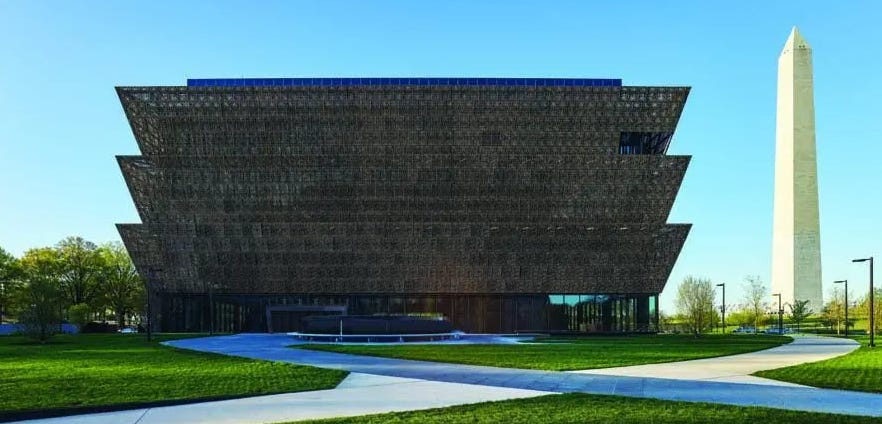
I was in Washington DC with friends over Labor Day weekend, and as we were walking, we came across an eyesore of a building. The dialogue between us went as follows:
Woman 1: What is that building? It’s so ugly.
Me: Hopefully it’s an IRS building.
Woman 2: I think it’s the African American museum.
Woman 1: Oh.
If it had been an IRS building, then at least we could unabashedly proclaim a fittingness of its grotesque exterior (not to worry, the IRS building has a foreboding grandeur instead).
We intuitively connect a building’s exterior with its function. Historic churches understood this point best, as they attempted to point the soul to Heaven by their beauty. The best of them stand as witnesses to incalculable sacrifice and devotion, such that they become an offering of sorts to God. When walking inside such ornate churches of antiquity, one quickly realizes that the people who designed and built them were not aiming for minimalism or for the least that would serve a task. They were building with recognition that the people who entered had souls, and would be formed by what they saw and where they worshipped.
We too must design, build, and name as if the people of our cities have souls. We might trivialize something as small as a sculpture outside of a museum, but when combined together, seemingly minor identifiers of a culture can be important for making a people feel that they belong. We have become so individualistic and utilitarian as a culture that it can be difficult to acknowledge a need for group identity.
Yet those on the Left, who excel in group dynamics, have been waging this war for decades. As they toppled statues, renamed buildings, and sullied American heroes, the Right opposed those moves verbally but provided no real counter response.
By effectively ceding the field, we allow young people to mature with a diminished sense of belonging. In so doing, we give them no sense of duty or responsibility toward what they inherit. To them, the country can feel much more like a mere collection of corporations than a people with an identity and a culture. That impoverishment leaves them vulnerable to the communistic blandishments that they will be exposed to in modern academic settings.
In his post-apocalyptic novel, A Canticle for Liebowitz, Walter M. Miller Jr. describes a society in which the culture no longer points toward the good:
“For Man was a culture-bearer as well as a soul-bearer, but his cultures were not immortal and they could die with a race or an age, and then human reflections of meaning and human portrayals of truth receded, and truth and meaning resided, unseen, only in the objective logos of nature and the ineffable Logos of God.”
We must remember that our culture too, is not immortal. We have to decide what unites us as a people, what symbols represent who we are, and whether the distinctiveness of our culture is worth defending. If we do not defend and actively assert these things, then they will be effaced until we no longer recognize the ground upon which we stand.
Given the systemic hatred for White people that's been slowly developing for almost 60 years, it's only natural that the carriers of that hatred, whose goal is to eliminate "Whiteness," would simultaneously want to eliminate every remnant of White culture.
Because man's soul is made in the image of God, one could argue that architecture and public symbolism reflects the state of the soul of man. Every century from the beginning of time tells the story of its people and their belief system. Virtue creates Beauty. Sin creates ugliness. The balance will fluctuate accordingly. I for one, cheer the goodwill of President Trump in working to restore the basic civic duties of man and country.