

What does it indicate when citizens of a nation are being persecuted for flying their own country’s flag… in that country? There comes a time when it is no longer untoward to conclude that a nation has been conquered, and instead must be accepted as the most reasonable conclusion. In England, patriotic Britons are engaged in a protest that consists entirely of flying the St. George’s flag, which is the flag of England.
If that is a protest, then how would one support the current regime? What flag would be flown in support of the current power structure? Interestingly, outside of the St. George’s flag and the Union Flag, one appears free to hang any other nation’s flag in Britain.
Protesting Britons are placing the flags on lamp posts and street benches, which are then quickly removed by law enforcement or supporters of mass unchecked immigration. At least one roundabout has been illicitly painted in the flag’s colors to compensate for the removals. Online activists have suggested painting the inside of potholes with flags, thus making better use of police time. For over a decade, those who place such flags on their houses outside of football (“soccer”) season are visited by police. They are told that the flag is offensive, is hateful, or is unwelcoming. Under current British law, it can be a criminal offense to cause offense.
We must ponder how it can be asserted that the British flag is offensive to some people, presumably non-British people, thus necessitating its erasure, but a foreign flag from somewhere like Pakistan or Iraq may be flown without regard for how many British people are offended. It’s a strange dynamic in which the native majority is reduced to an inferior class.
If the flag is no longer representative of the existing government or power structure, we might consider what it does represent. The people who fly it as an act of defiance and protest are pointing not just to a place, for that stands beneath their feet, but to a time. They are remembering a time when the British were a people. They are heralding a set of values long since dismissed or at least disfavored, replaced by self-erasure and preferentialism for “the other.” In this replacement of values, cowardice is masqueraded as virtue.
There is at least a partial collective memory of what once was, and a sense that things are not as they ought to be. Hence, Britain seems to be in a state of unrest as a regular occurrence, whether through riots or widespread protest movements by the last remaining people in the nation to reminisce about what Britain once stood for. Even then, one fears that they understand Britain only in a romantic notion—without even a nod to the Faith that undergirded that former society.
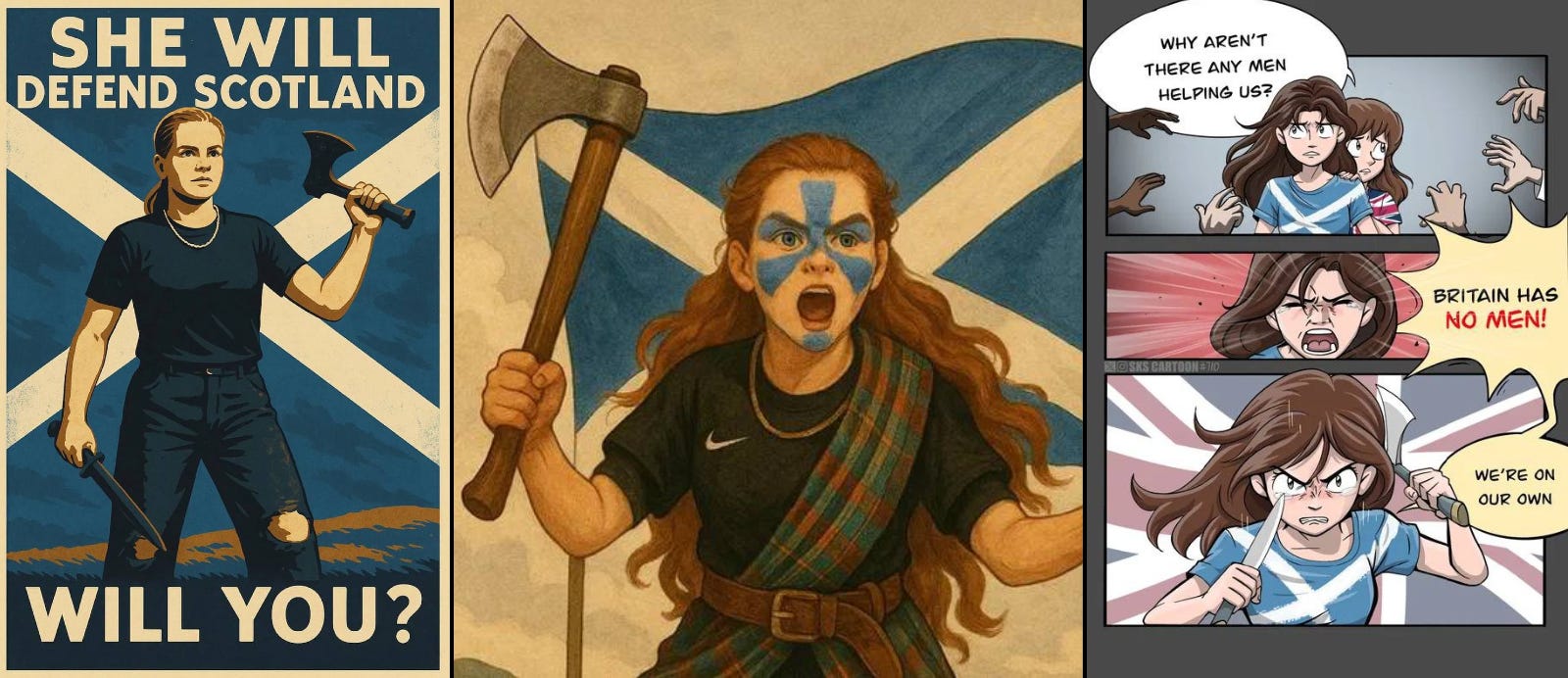
A recent video in which a Scottish schoolgirl brandished a knife and an axe to hold off an aggressive, taunting immigrant has exploded in internet circles. After all, it is horrendous that a girl of that age would feel the need to carry such weapons, and it attests to the frequency of British children facing such harassment. Then, her fears were validated on camera for all to see.

Is it possible for a British schoolgirl to retain the innocence that one ought to have at such an age? For example, is it feasible for a girl living in modern Britain to be free of the expectation that she will face harassment, that she will be viewed sexually, and that she might need to defend herself? The girl was later arrested and charged for possession of the weapons. Law enforcement seem disinterested in changing an environment in which young girls fear for their safety without any reliance or trust in law enforcement or the courts. The arguments that a child should not have been carrying such weapons never seem to acknowledge the reality that no child should be forced into situations where they feel the constant need to defend themselves.
Those who understand the conditions she faces have already made her into an icon of the fight against mass, unchecked immigration and male cowardice:
In the United States, President Trump is attempting to criminalize burning the American flag, even by people who have purchased it. While that legal battle is a topic about which reasonable people may disagree, we should at least celebrate that the President feels a camaraderie with the nation’s flag and what it represents.
What we see, then, is not merely a clash of symbols, but a slow unraveling of identity. A people who are told that their flag is hateful, that their daughters must fend for themselves, and that their very presence must yield before the sensitivities of others, are a people already dispossessed. The English flag invokes the memory of a nation, a fragile relic held aloft by those unwilling to forget, and which thereby represents a threat to those who wish the country’s borders to dissolve along with her identity.
The tragedy is that what was once an ordinary act of loyalty has become a feat of desperation. To fly the flag is to admit that it no longer belongs to the ruling powers, but only to the scattered remnants of a people who sense, however dimly, that they are being written out of their own story. Symbols can endure for a time, but when they are stripped of the reality they signify, they become merely haunting reminders of what has been lost.
THANK YOU, much needed and well said!
Sarah, we both know that no politician will make meaningful changes or act, ever because:
- Career sui*ide for any politician who proposes mass deportations
- Media would destroy anyone who proposes actionable legislation
- International pressure and sanctions would follow (WEF/UN)
- They're ideologically captured, they genuinely believe protecting predators is more moral than protecting children
- (last but definitely NOT least) They live in bubbles where their own children aren't at risk