

The sheer size of the crowd at Charlie Kirk’s memorial brings one pause, because it speaks not to the impact that he had when he was alive, but that which he achieved in death. Said plainly, the memorial service brought more people than any Turning Point event that he hosted. In this, we see a small window into a former world, one in which people regularly died for what they believed, and did so knowingly.
Anyone who has taken even a cursory glance at the early Church has read how the martyrs caused her growth. “Martyr” comes from Greek, meaning witness. Those Christians who gave their lives attested to a truth (or a love) that they were willing to die for. It can seem very abstract and foreign to us today, especially here in the West where suffering is avoided and all of our material needs are met. We can feel confounded at the notion that people would have looked upon Christians dying for the Faith, being tortured to death publicly amidst mockery and jeers, and been attracted to that cause. It seems counter to nature that such a persecuted people would grow in number, but they did.
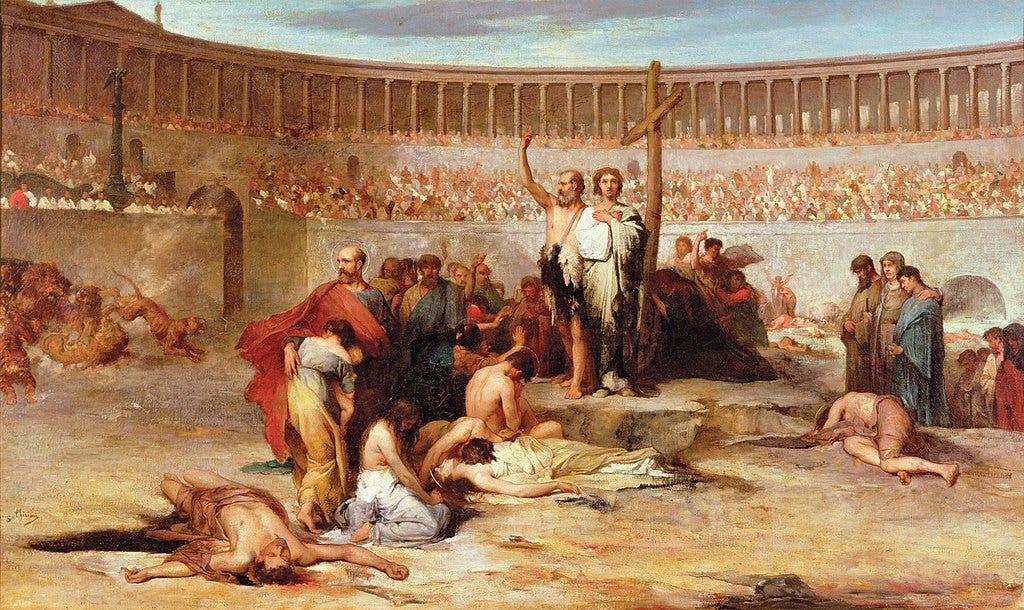
While it is not the case that Charlie Kirk was a Christian martyr in the strict sense, for he wasn’t killed for his faith, we can say that he was killed for expressing the truth as he knew it, and therefore that his death has functioned socially like a martyrdom. We can see the results of that on the people he leaves behind. There are reports that over 200,000 people attended his memorial service in person, and it was watched by 20 million people from home. His reach increased exponentially due to how he died, and ironically because of an attempt to silence him.
In an age so averse to suffering, it’s easy for us to presume that people would be repelled from the ideas that Charlie espoused out of fear, but that’s not what we see. We are designed for so much more than material comfort, and we are necessarily attracted to manifestations of virtue, like courage and magnanimity. The society in which we live is thus not particularly conducive to human flourishing, because it leaves us empty. The very amenities that are supposed to cause our contentment can cause an emptiness of the soul, in which we search for meaning but find ourselves parched. Without a higher love, even abundance becomes sterile. That is why we all ought to have something—someone—for whom we are willing to die. It’s a love that we were made for.
It is rare today to have leaders who inspire because they themselves lack conviction. In their place, we are fed insipid luke-warm diplomacy that seeks to coddle via self-erasure. We have grown numb at the over-exposure to the banal. The “leaders” that are foisted upon us seek the unity of commonality at the expense of the truth that martyrs died for. Such men can neither lead nor inspire.
The Epistle to Diognetus, published around 130 AD, paints a picture of who Christians were in an age of widespread persecution:
“Christians love all men, but all men persecute them. Condemned because they are not understood, they are put to death, but raised to life again. They live in poverty, but enrich many; they are totally destitute, but possess an abundance of everything. They suffer dishonor, but that is their glory. They are defamed, but vindicated. A blessing is their answer to abuse, deference their response to insult. For the good they do they receive the punishment of malefactors, but even then they, rejoice, as though receiving the gift of life.”
Their lives were recognizably transformed by their love of Christ, often tested to the point of death. Despite the persecutions, they did not become like their persecutors, and instead continued to live differently, rejecting the pagan world that surrounded them.
There’s a great longing to be part of something important, to do something that has meaning beyond the bank account. However, the predominant ideology of today is one that claims progress in technology and in the rejection of religion. The finale of that atheistic quest is merely demoralized man, because it’s the collective yearning for a future defined principally by an absence, by the a-theism, and ultimately the a-purpose for being.
Eventually, that ideology that left people empty will be rejected on the personal level, and then on the political stage as well, as we are beginning to see. Some are panicking that the Charlie Kirk memorial was a nod to Christian Nationalism. That’s a term by which people mean different things, but if the fear is that Christian people are beginning to think, speak, and act in Christian ways, and that they wish to form government on the recognition of that truth, then yes, that is emerging. It repudiates an ideology that strips man of his purpose, saps his strength, undermines his family, and leaves him hollow.
What we saw in that memorial was not simply mourning, but a reminder that when truth is spoken with courage, it cannot be silenced. Those who dare to speak will only grow in number and in zeal.
Charlie Kirk was a man who was doing the impossible. He was engaging young people in open, honest and non-violent debate. Through his dialogs, young people were beginning to question the unquestionable dogma of the left. They were beginning to think for themselves and to come other conclusions rather than just blindly follow unquestionable dogma.
While it is seemly that the truth should finally be foremost, I fear the difficulties that truth can engender in those unwilling to accept it as such will lead to the unravelling of our society, and that right smartly.
There seems to be little time left, before the cascade of interlocking failures renders us unable to preserve our ways. Events accelerate, and the descent has certainly begun.
I pray everyone is ready for what the Remnant will soon have to endure.
Mike in Canada