

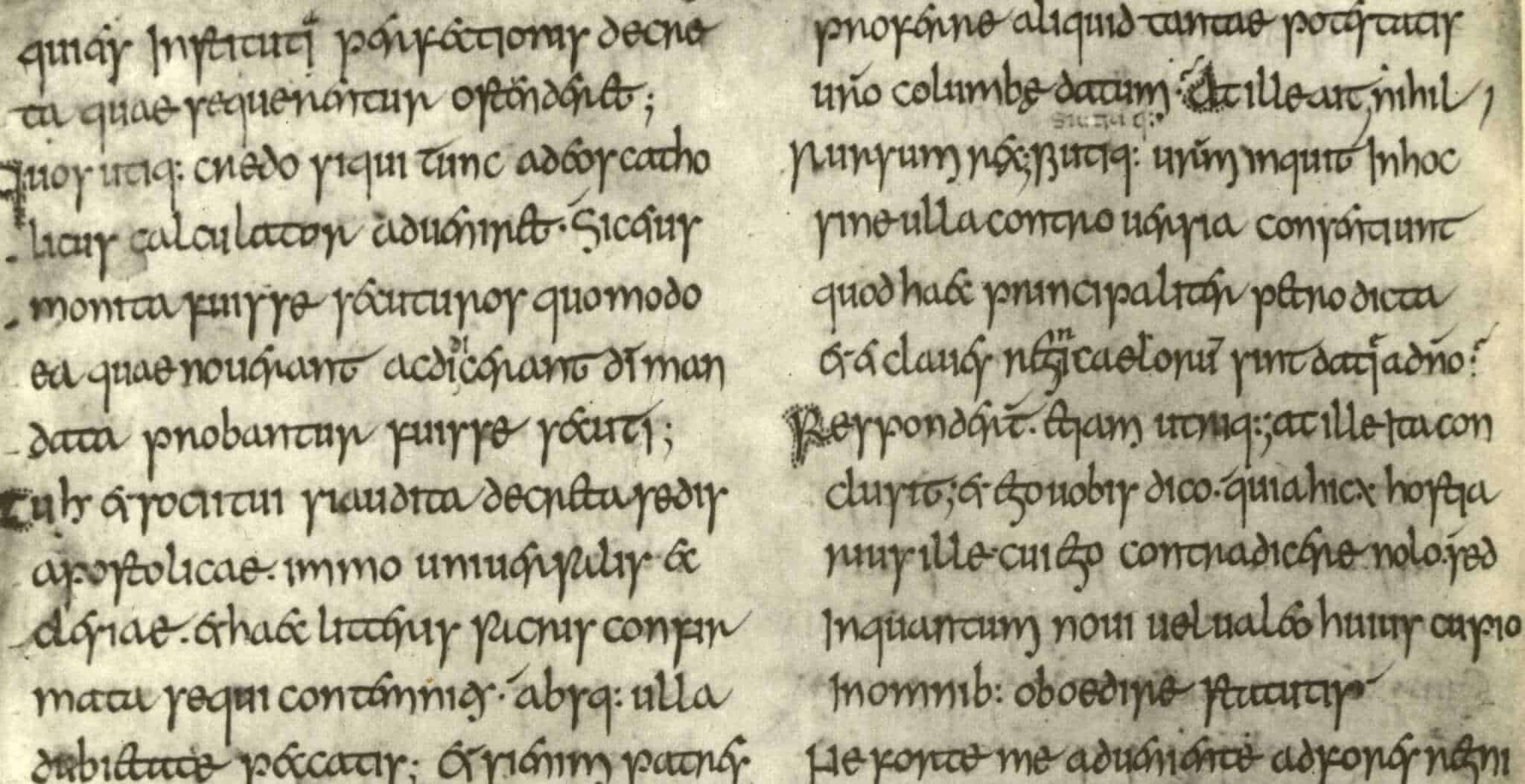
One of the (few) things praised about the Catholic Church by secular people is that she kept a history during the times when nobody else did. Monks kept writing in monasteries even in times of great decay and upheaval, copying old manuscripts and ensuring that people could know from whence they came.
St. Bede the Venerable, whom we remember most particularly today (on the old liturgical calendar), was a giant amongst those monk-scholars. He is known for writing the Ecclesiastical History of the English People in 731 AD. Take a brief look at these chapter titles:
Chap. II. How Caius Julius Caesar was the first Roman that came into Britain.
Chap. III. How Claudius, the second of the Romans who came into Britain, brought the islands Orcades into subjection to the Roman empire; and Vespasian, sent by him, reduced the Isle of Wight under the dominion of the Romans.
Chap. IV. How Lucius, king of Britain, writing to Pope Eleutherus, desired to be made a Christian.
Chap. V. How the Emperor Severus divided from the rest by a rampart that part of Britain which had been recovered.
Chap. VI. Of the reign of Diocletian, and how he persecuted the Christians.
Chap. VII. The Passion of St. Alban and his companions, who at that time shed their blood for our Lord.
Chap. VIII. How, when the persecution ceased, the Church in Britain enjoyed peace till the time of the Arian heresy.
Chap. IX. How during the reign of Gratian, Maximus, being created Emperor in Britain, returned into Gaul with a mighty army.
Chap. X. How, in the reign of Arcadius, Pelagius, a Briton, insolently impugned the Grace of God.
Chap. XI. How during the reign of Honorius, Gratian and Constantine were created tyrants in Britain; and soon after the former was slain in Britain, and the latter in Gaul.
Chap. XII. How the Britons, being ravaged by the Scots and Picts, sought succour from the Romans, who coming a second time, built a wall across the island; but when this was broken down at once by the aforesaid enemies, they were reduced to greater distress than before.
Chap. XIII. How in the reign of Theodosius the younger, in whose time Palladius was sent to the Scots that believed in Christ, the Britons begging assistance of Ætius, the consul, could not obtain it. [446 a.d.]
Chap. XIV. How the Britons, compelled by the great famine, drove the barbarians out of their territories; and soon after there ensued, along with abundance of corn, decay of morals, pestilence, and the downfall of the nation.
Chap. XV. How the Angles, being invited into Britain, at first drove off the enemy; but not long after, making a league with them, turned their weapons against their allies.
Chap. XVI. How the Britons obtained their first victory over the Angles, under the command of Ambrosius, a Roman.
Chap. XVII. How Germanus the Bishop, sailing into Britain with Lupus, first quelled the tempest of the sea, and afterwards that of the Pelagians, by Divine power. [429 a.d.]
The list continues for 24 chapters. Audiobook versions last for about 12 hours.
St. Bede popularized the dating system based in relation to Christ’s death, anno Domini (AD).
While we naturally look on such a tome with a sense of awe and wonder, we might consider the objection, “Why?” Why does it matter when the first Roman entered Britain, or what Diocletian did, or any of it? We are so far removed from those happenings, as were the people of his day.
It’s an important question because so much of modernity insists that history is important only to the degree that it aids in “progress.” Scientific and industrial progress are promoted as a sense of movement without terminus, and our history is merely put to use in the advance of that nebulous cause.
Christians have long treated history rather differently, both on the collective and singular level. Notice that individuals in the Christian West feel compelled to bring flowers and mementos to the grave sites of their loved ones. They visit so as to re-remember, and to pay a type of homage. In a similar vein, Memorial Day was originally called Decoration Day, from a ritual in which people would decorate the graves of the fallen after the Civil War. While that practice has lost favor with most on the holiday, it too speaks of how we once sought a kind of collective memory. Even today, the holiday marks a memory of those who willingly gave their lives in sacrifice. We do all of this not because it is productive, but because it is good.
We fear forgetting any attribute of our loved ones, a pain so deep that it can become a secondary cause of grief—like we haven’t just lost them—we have lost who they were to us. We can love people such that they become part of us, and their parting makes us feel unwhole.
This acceptance that we are social creatures by nature, somewhat interdependent and shaped by our memories of loss, was once a normal understanding of man. It is the modern, heavily industrialized world that asserts that man exists primarily as a worker and his value lies in his output (to catastrophic consequence).
So when St. Bede wrote his chronology, he was helping us not to forget about our losses, and about those who formed us as a people, through battles and through sacrifice. Moreover, he was reminding the people of the 8th Century why. The stories of endurance are ultimately tales of loves, for love and sacrifice are inseparable.
Our contemporary attempts to be a people without a history, defined only by the present and ungrateful or even resentful of the past, leaves us incomplete. It condemns us to being un-formed, without a shared sense of loss, growth, values, or aim. It impoverishes us of that which can provide unity to a people and a sense of belonging to a person.
Our memory, properly oriented, points both forward and backwards—back to those who sacrificed that we might thrive, and forward to a time when we might see them again.
Really enjoyed this - In my school days nothing happened before 1066.
In my later years I have become very skeptical of history and particularly what any government or politician says . There are many books that demonstrate the lies we have been told over the decades and centuries.