

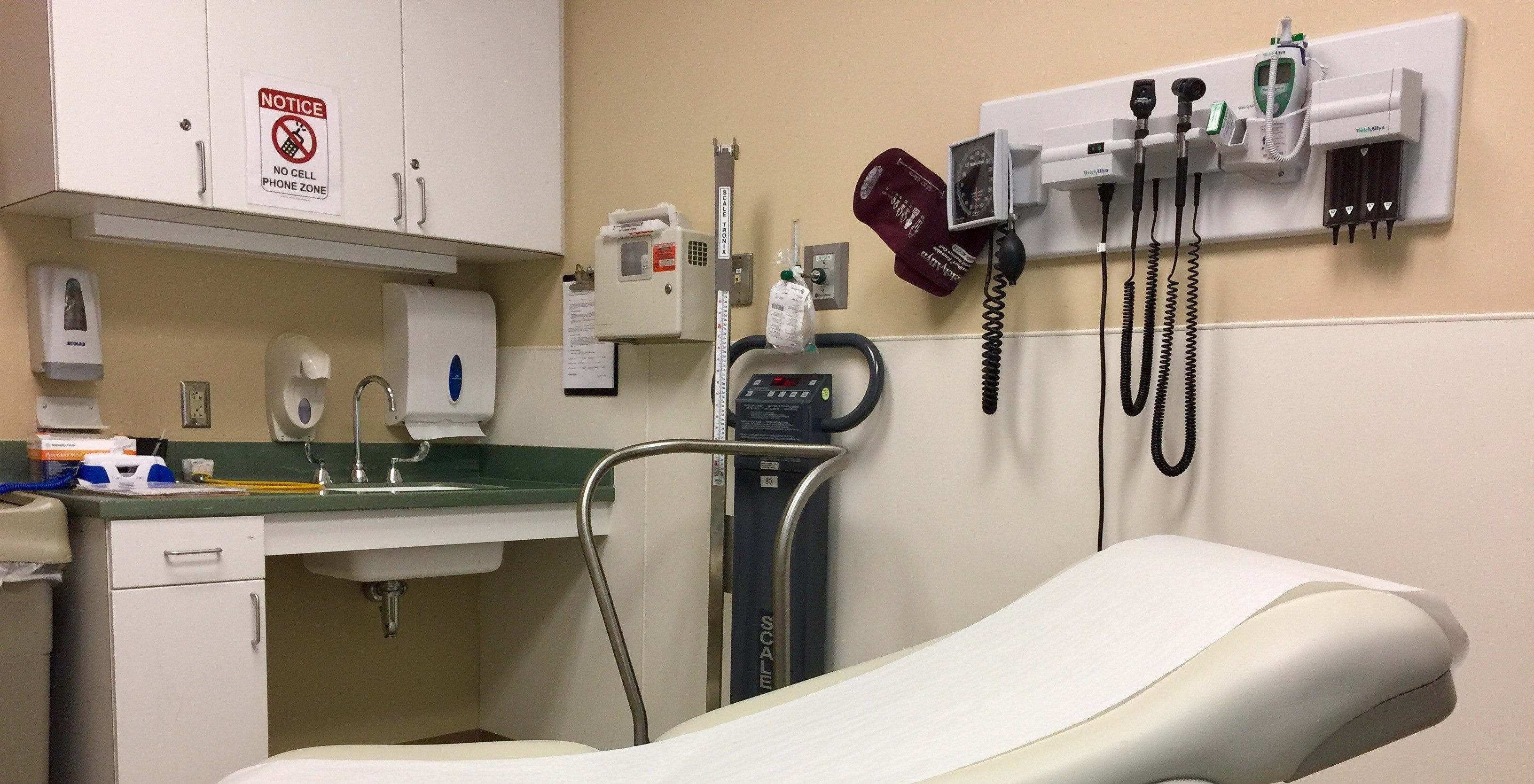
It’s the sterile office in which you wait for the doctor to enter, after having spoken to seemingly everyone else—repeatedly describing your problem, first to the lady at the front desk, then a nurse, then a doctor’s assistant. This is how we maximize use of the doctor’s time, you see. With a carefully orchestrated choreography, he can spend just a few moments with each patient.
As you look around the room, your time being judged of significantly less value than his, you notice the embodiment of utilitarian decor. The bed has a rubber exterior so that it can be wiped off easily, the chair has no cushion that might flatten over time, and everything is a light shade of brown. The surfaces would look clean even if they were not.
If humans were machines, this is how we would decorate our homes. We would make every choice about efficiency. We would ask how long the materials will last without regard to whether we should want them to. Our homes would be cold but functional. They would not befit people who had souls.
The doctor knocks on the door while entering, in one seamless motion. After a greeting that feels corporate and rehearsed, he prepares to tell you about an app on his phone. It will listen to your conversation and use AI to make his notes. He looks at you longingly.
“Do you consent?”
Do you? On the one hand, the AI will ‘listen’ better, which is to say that the notes will be more thorough. They won’t omit a key detail that you keep telling doctors but they seem to be too rushed to listen. It will at least be in the notes, as a testament to how you tried, even if nobody acted on what was said.
On the other hand, because the doctor likewise knows these things, he will be less likely to listen himself. He can trust the machine to do it for him. It’s not like he can forget anything, he assures himself. But what the AI cannot do is make him care. It cannot replace the quiet human attentiveness that allows a good physician to hear what isn’t explicitly said. AI notetaking might relieve one burden, the task of note taking, but because human nature is so predisposed to complacency, it creates another problem entirely. Our over-reliance on tools can cause an atrophy of the mind.
With ever-growing bureaucracies requiring so much more paperwork than time with people, it’s harder for the modern physician to care. When we’re exhausted and burned out, we become cogs in a machine, just trying to get through the day. Doctors spend twice as much time dealing with paperwork than they do speaking with patients. Moreover, the days of a doctor dealing with familiar people in a small town are long gone. He knows people by their aches, pains, and chronic illnesses, not by their dreams and loves. It’s efficient this way.
But is it how we want it?
It’s true—there’s “no turning back the clock,” as some will jeer at any notion that a slice of history could have been better. But we can learn from the past, and we can care enough about humanity to try to make spaces and experiences warmer. Else, we will keep building brutalist buildings with the practicality of a doctor’s office and treat people as mere projects to be fixed.
If we look broadly at the way people are regarded in contemporary society, the trajectory is alarming. The relationship between workers and employers has lost all of its warmth, patients are viewed through a business-like lens, and entertainment spaces are becoming scarce. As we try to maximize efficiency, we lose the humanity. In some sense, to be human is to be inefficient, because we were made for more than mere output. Until we remember this, our path inclines downward.
Just 25 years ago (it seems like a lifetime), my doctors had comfortable rooms with windows, did not sit staring at a computer the maximum time I was there, sat in a chair in front of you and looking at you, asking questions, waiting for my reply, and then coming to some sort of conclusion with recommendations and then waiting for my approval or more questions.
Although none of my doctors use AI to take "care" of me (yet), all sit across the room attached to a computer asking questions the CDC instructs them to ask and then comes over to me to examine me if their 10-15 minute maximum would not get them in trouble with the corporation that owns the practice.
My rheumatologist requires a questionnaire to be filled out prior to seeing her but she never, ever goes over it. We sit in a small windowless room. She spends less than ten minutes away from the computer, rarely touches me, and doesn't seem interested in me at all.
I'm old enough to have had the luxury of having my doctor come to my home and lucky to have two doctors in my neighborhood who would come if my doctor could not.
I left my doctor of 25 years in 2021 when I finally figured out he cared more about catering to gay ideology than patient care. My new doctor doesn't take insurance. Listens attentively. Has an icon of Our Lady of Perpetual Help in the waiting room.