

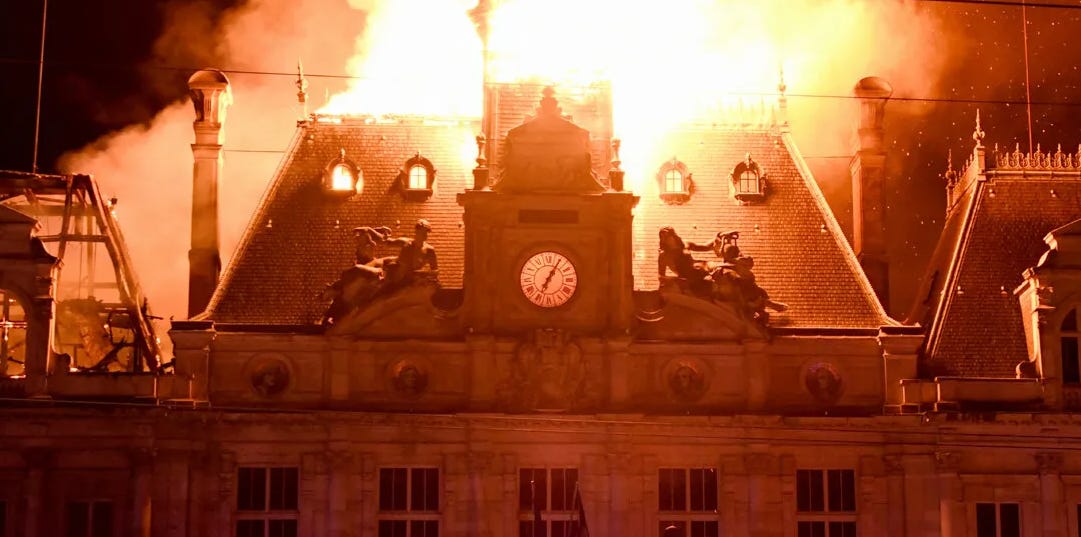
France never seems too far from a rambunctious protest-turned-riot, so even when engulfed streets reach our press, few raise more than an eyebrow. But there is something fascinating about the Marxist-Islamic alliance that is behind the flames.
On the surface, the far-left and the social policies of wanton openness have nothing in common with the religious rigidity sought by Islamists. Yet, both find the West an enemy to be destroyed. Both abhor the Christian underpinnings of Europe and seek to burn the lasting symbols of former ages.
The open border policies of the Left are the conclusion of an ideological assertion that there is nothing domestic that is worth defending. It is only within that framework that it is defensible to usher in hordes of Muslim men. Further, it is asserted that Europe is built on oppression and there is therefore a kind of equalizing justice in opening one’s doors to foreigners who have not played a role in the raising of such repressive institutions.
So many of those imported Muslims likewise look upon all things recognizably Western as deserving of destruction, not because they are “patriarchal,” but because they represent an enemy that would (and did) prevent the spread of global Islam. Ironically, Mohammadans so often sneer at modern Western institutions for not being patriarchal enough, which one could see as comedically tinted when considering the feminists who simultaneously promote open borders to followers of Islam while trying to emasculate Western institutions.
So the political Left brought the arsonists who would burn the streets of France with impunity. Together, their alliance brings about the next stage of purging. Let us not forget that as dire as recent pictures of burning France look, the French Revolution that sought to similarly sever France from her history and her Faith was far more bloody. Modern France is in no small part rooted in the godless anarchy that saw nuns slaughtered for their fidelity.
It could even be said that the France that now burns does so as a result of a long-standing, nihilistic ethos that reframed the purging of history with the euphemistic label of Enlightenment. A callous rejection of the past does not necessitate a future of decency or betterment. Instead, it vaporizes the attachments that give people a sense of duty to their posterity.
When we of the Christian tradition see a building of beautiful, classical architecture in flames, we rarely merely lament—we grieve. We feel an almost personal sense of loss, even for a place we have never been and likely would never go. Our collective loss as people of this shared tradition is felt individually, because that is what it means to have a culture. One should feel a part thereof—connected to its art, architecture, music, and faith. We are already almost severed from it, such that we look upon such places as reminders of our history rather than of our shared home.
It is no wonder then that foreigners should wish its destruction. Yet herein, one can more fully understand the type of betrayal being perpetrated by those who seek to tear down what was theirs by inheritance, but which they declined to receive.
As we watch Europe burn, and as we feel pangs of grief, let us understand why. In our history, and God willing in our future, there are physical reminders of our search for the good, and of our reaching for the beautiful. In the Western tradition that we called Christendom, we attempted to build in recognition of the soul of man, that he might be uplifted to a higher mode of living, so as to better aim for his permanent Home. That was never a flawed idea, but rather was representative of our shared Faith. While we may be heading toward turbulent times, we must recollect that what guided our former brethren to aim so highly might also guide us when it is time to rebuild.
Having been educated almost 60 years ago, one thing I learned is that France has been burning, intermittently, since 1789. It is sad to see the “eldest daughter of the Church” play the whore. Of course, I know that the “free French,” with their attachment to the faith and their families and to the soil, are not part of this, but they are silent. And silenced.