

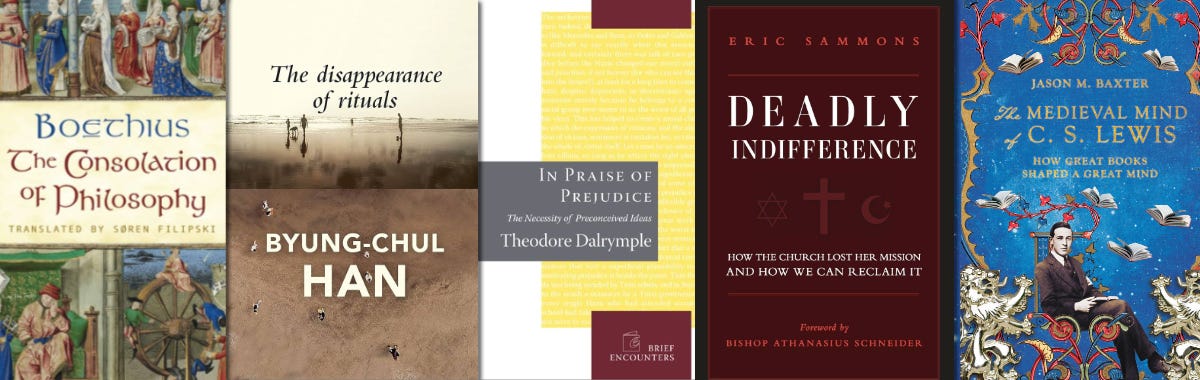
I believe very strongly in keeping alive the tradition of reflecting on one’s reading victories at the end of each year. They are indeed victories, given the ever-expanding quantity of books available, and thus how unlikely it is to put one’s hands on a gem. AI now threatens to further flood a market previously over-saturated by ghostwriters, helping to maintain the fiction that our celebrity class is literate.
I typically read between 30 and 45 books a year, depending on the length of those books and the distractions of life. At least ten are generally duds, which is to say that they didn’t change my soul. I realize that that’s a high bar, but I have no regrets. Our souls are constantly being inclined in one direction or another. If something produces nothing but a milquetoast shrug, it probably wasn’t worth interacting with at all.
That said, I adore some of the books that I read, and I find close companions in them. So, when I must choose only five, I refuse to choose favorites among them thereafter, for I do not wish to whittle further. Thus, they are provided without any order at all. All of those listed below are gems, and I consider myself grateful for having read them.
The Consolation of Philosophy by Boethius
I read this book after listening to another one that is on this list (below), because Boethius obviously had such a profound impact on C.S. Lewis.
Imagine being on the ancient equivalent of Death Row. You were a high-ranking Roman statesman, but now you find yourself falsely accused of treason, and await a brutal death sentence. It was in that environment that Boethius wrote a masterpiece about what little we are owed, what we can know about God, and how we ought to understand the negative things that happen to us. It is, surprisingly given the circumstances of its birth, a consoling read.
The Medieval Mind of C.S. Lewis: How Great Books Shaped a Great Mind by Jason M. Baxter
To say that I adored this book is an understatement. The exploration of the medieval mind and the way that the ancients understood everything (time, chance, fate, etc) was invigorating. I primarily listened to it while driving back and forth to the Traditional Latin Mass on Sunday morning drives, and it seemed to be the perfect companion. There were moments in which I audibly exclaimed, “Yes!”
It alludes to Lewis as something of a Time Traveler, in that he spent so much of his energy and imagination in a time that was not his own. That is not a detraction, but a call to how we ought to be, if only because by immersion in other ages, we become aware of the errors of our own age (and hopefully immune to them).
In Praise of Prejudice: How Literary Critics and Social Theorists Are Murdering Our Past by Theodore Dalrymple
I enjoyed this one so much that I wrote an entire review of it, titled Judge, Discriminate, and Hold Prejudices. Read that full review, or just enjoy one of my favorite quotes from the book, which stands entirely on its own:
“Egalitarians may deny that they desire exact equality of outcome, but they have great difficulty in specifying exactly what degree of inequality is acceptable to them. That is why there are so many studies that examine inequality, whether of income or of some other marker, and why any increase in inequality is lamented as evidence in itself that an injustice has been committed. This, no doubt, is why you never see an increase in inequality praised as representing an increase in justice, as it might be—I do not say must be—if justice has anything to do with the rewards and penalties for individual conduct.”
Deadly Indifference: How the Church Lost Her Mission, and How We Can Reclaim It by Eric Sammons
If you are looking for a book that is uplifting, look elsewhere.
Truly, this was a really depressing read, but that wasn’t Sammons’ fault. It is a painful book because it chronicles how the Church shifted its messaging for the sake of ecumenism, at the expense of Catholics and Protestants alike. The rapid pace of that shift, and just how aggressively the new paradigm is parroted today, is heartbreaking. Sammons explains how “Inclusivism in theory leads to Pluralism in practice,” and why it is so important for us to fight against the narrative that has strangled the Church since the 1960s.
As a convert himself, I imagine that Eric understands the degree to which the Faith matters on the individual level, and shares in the sense of pain at the notion that we should not wish to speak this Truth into the world.
The Disappearance of Rituals: A Topology of the Present by Byung-Chul Han
Byung-Chul Han is a succinct writer, whose works at times remind me of Josef Pieper. He too is a philosopher, though he keeps his Faith much quieter than Pieper, and I think a greater recognition of the Transcendent would help to make his work stronger.
In this little book, he explains how rituals bind us in time the same way that a home might bind us in place. He analyzes the (largely areligious) rituals that have become less common in contemporary life. He explains how that absence has left us feeling isolated and disconnected from not only our fellow man, but also from those who came before us.
He talks at length about the modern attempt to sell ourselves, our opinions, our looks, and everything about ourselves that would have previously been shared with one’s family and community. He laments it as a reductionism ordered toward constant production. Here’s a quote from the book:
“Values today also serve as things for individual consumptions. They become commodities. Values such as justice, humanity or sustainability are exploited for profit. One fair-trade enterprise has the slogan: ‘Change the world while drinking tea.’ Changing the world through consumption — that would be the end of the revolution. Nowadays one can purchase vegan shoes or clothes; soon there will be vegan smartphones too. Neoliberalism often makes use of morality for its own ends. Moral values are consumed as marks of distinction. They are credited to the ego-account, appreciating the value of self. They increase our narcissistic self-respect. Through values we relate not to community but to our own egos.”
Please post your own favorite books of 2025 in the comments—especially those that changed you. While I mostly read non-fiction, there is no need to restrict your selections upon that criteria.
Thanks Sarah. I'm listening to Boethius on Audible. It is truly life changing and potentially culture changing if many more couldf listen to it with an open heart. Thanks for the tip and helping me move in a better direction toward the begionning of the new year
You cannot go wrong with "The Consolation of Philosophy" by Boethius. A very short read but very profound; it will cause you to pause and reflect. Highly recommend.