

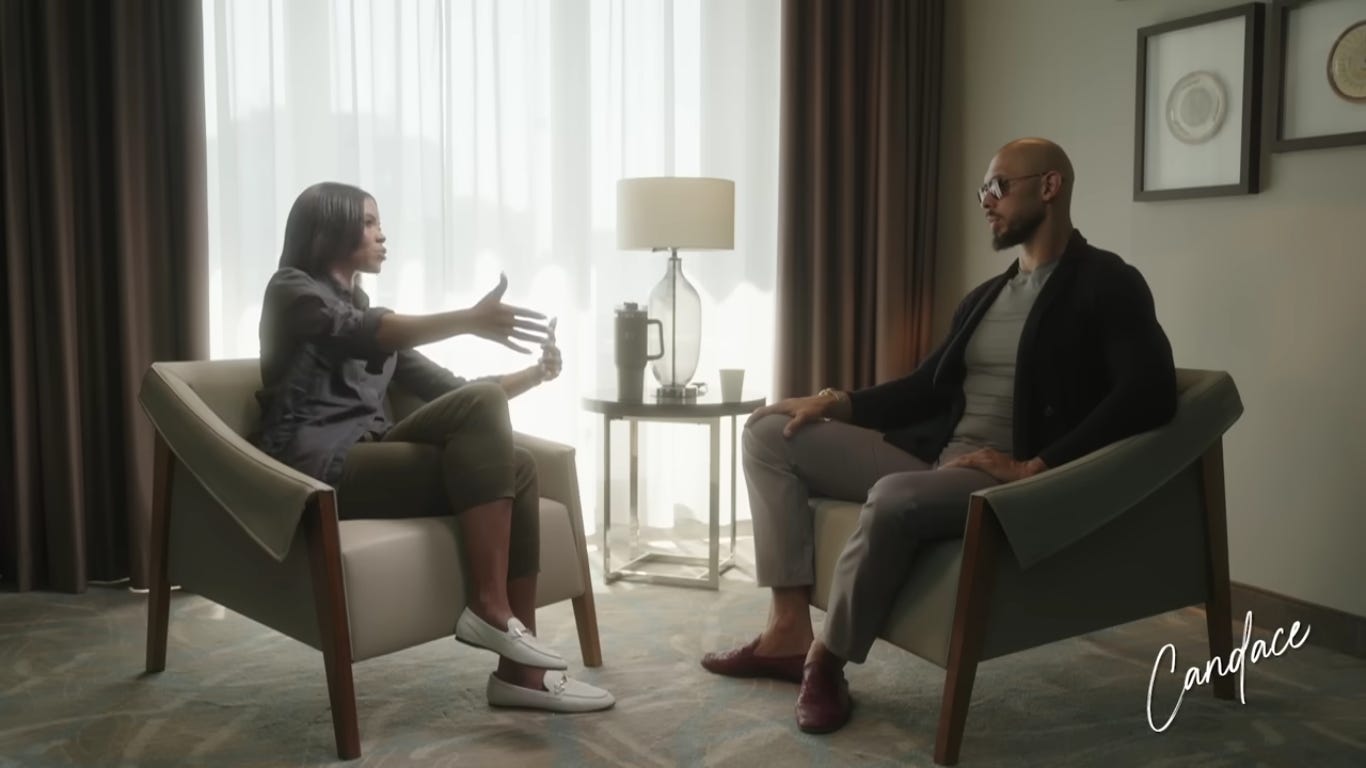
Andrew Tate has spent years building an empire on cruelty masquerading as honesty. This week, he and his brother Tristan have been arrested in Miami and are facing extradition to the UK due to an array of new charges. The most troubling question is not whether they will be convicted, but how they amassed an audience of millions of young men by equating degeneracy with masculinity.
The allegations against them are serious, but they are similar to those that have been made against the brothers for years in multiple countries. The latest charges relate to offenses between 2010 and 2017.
Andrew Tate faces:
Seven new counts of rape
Three counts of arranging or facilitating trafficking for sexual exploitation
Three counts of assault
19 counts of indecent images of children and extreme pornography.
Tristan Tate also faces new charges:
One count of sexual assault
Two counts of rape
Three counts of arranging or facilitating sex trafficking
In addition, they already face previous charges of rape, bodily harm, and human trafficking in regard to three other victims in Britain between 2012 and 2015.
The ‘manosphere’ influencers are actively fighting extradition back to Britain, but what is far more important is how they became such popular figures. For example, was it in doubt that the Tate brothers are awful people? They attracted vast numbers of young men despite running a pornography empire, bragging in public videos about abusing women, and facing repeated allegations of sexual assault.
Regardless of the public record, or worse, because of it, they achieved a massive following. That audience swelled when mainstream figures provided them with a platform and the air of respectability that comes with such appearances.
Tucker Carlson interviewed Andrew Tate and defended his conspiracy theory that he is merely being persecuted for being “in favor of the West” and for speaking with uncommon candor. Nick Fuentes, allegedly a Catholic commentator, has defended the Tate brothers repeatedly. Candace Owens interviewed Andrew and used him as an example of authentic masculinity. Her video description was, “I sit down with Andrew Tate to discuss the dangerous thinning of Western culture, the importance of street smarts, and what motivates the global elites.”
Whether a criminal trial convicts them or not, both men have been recorded saying and doing diabolic things. And they have millions of followers because of it. In fact, when Catholic commentator Matt Fradd posted on X in favor of the pending extradition, the comments on his post were flooded with accusations that he had sold out or was working “for the Jews.”
Those who defend the Tate brothers often do so by expressing that they appreciate the “authenticity” or how “honest they are.” One might better argue that the brothers simply tell the audience what they want to hear: that you can and should treat everyone around you like objects, and in doing so, you can become rich and famous. It enables those who do not want to live virtuously to reward their own egos by re-casting themselves as conquerors instead of monsters.
There is a not-so-hidden assertion in the midst of this that being crass is more truthful and “authentic,” as if our nature is inherently so debased that rolling in excrement might be the greatest expression of authenticity. But it is not the case that to be indecent or uncivilized is to be honest.
Among young men who are tired of effeminate leaders and highly processed bureaucratic speech, there is a confusion between civility and manipulative speech. Manipulation is really a type of lie, and is thus not at-one with civility at all. It is neither the case that to be decent is to be dishonest nor that indecency is mere sincerity. Said differently, it is possible to be good—for your aspirations to be noble, your speech both decent and truthful, and your actions admirable. It is simply hard.
C.S. Lewis reminds us, “No man knows how bad he is until he has tried very hard to be good.” Those who have not tried to be good (by the objective standard of the saints, not one’s own excuses), are ignorant of the difficulty of the task. It is hard to bear responsibility for one’s position, to act in accord with the highest decency possible, and to choose to be virtuous.
There’s an irony that we cannot overlook in the “redpilled” celebrities who pretend to be defending the West while denigrating chivalry, fatherhood, family, marriage, and decency. What of the West do such men seek to defend? The ‘values’ they are espousing are far more akin to the Ottoman invaders than to the city-states that were threatened by them.
Another common defense of the Tate brothers is that of whataboutism. This is the reflexive assertion that if charges have not been filed against Epstein’s friends and the Muslim rape gangs of England, that these charges somehow should not proceed. “What about…!,” its proponents scream. But not everything is a mere political battle. There are real victims in these cases for whom we should desire justice. We can long for swift justice in all of these scenarios, but we should celebrate whenever any move in the right direction is made, rather than sneering and making comparisons to other areas of law enforcement impotency.
In seeking justice across all of these cases, we herald the good and work toward a society that is “Western” in every positive sense. We cannot endure the delusion that the Tate brothers were merely “two brothers who told the truth,” nor that being crass or abusive is demonstrative of a life well lived. It is not authentic to lack control of oneself. It is not powerful to lack civility, and it is not good to choose evil.
I don't keep up with the goings on in this perverted world as much as possible so I never heard of these two brothers. However, it doesn't surprise me that they are so popular as those who are most perverted and evil are glorified and held as idols in the world which is controlled now more than ever by the lies of the fallen angels and demons and the one bulwark against the progress of evil, the Catholic Church, has been sent into the catacombs by those who infiltrated it and who also are controlled by the same lies.
It's amazing to me how your writing many times echos my thoughts. My wife saw the headlines about the Tates and asked me who they were. My response was nearly identical to your points. However your writing expresses the points better than me.