

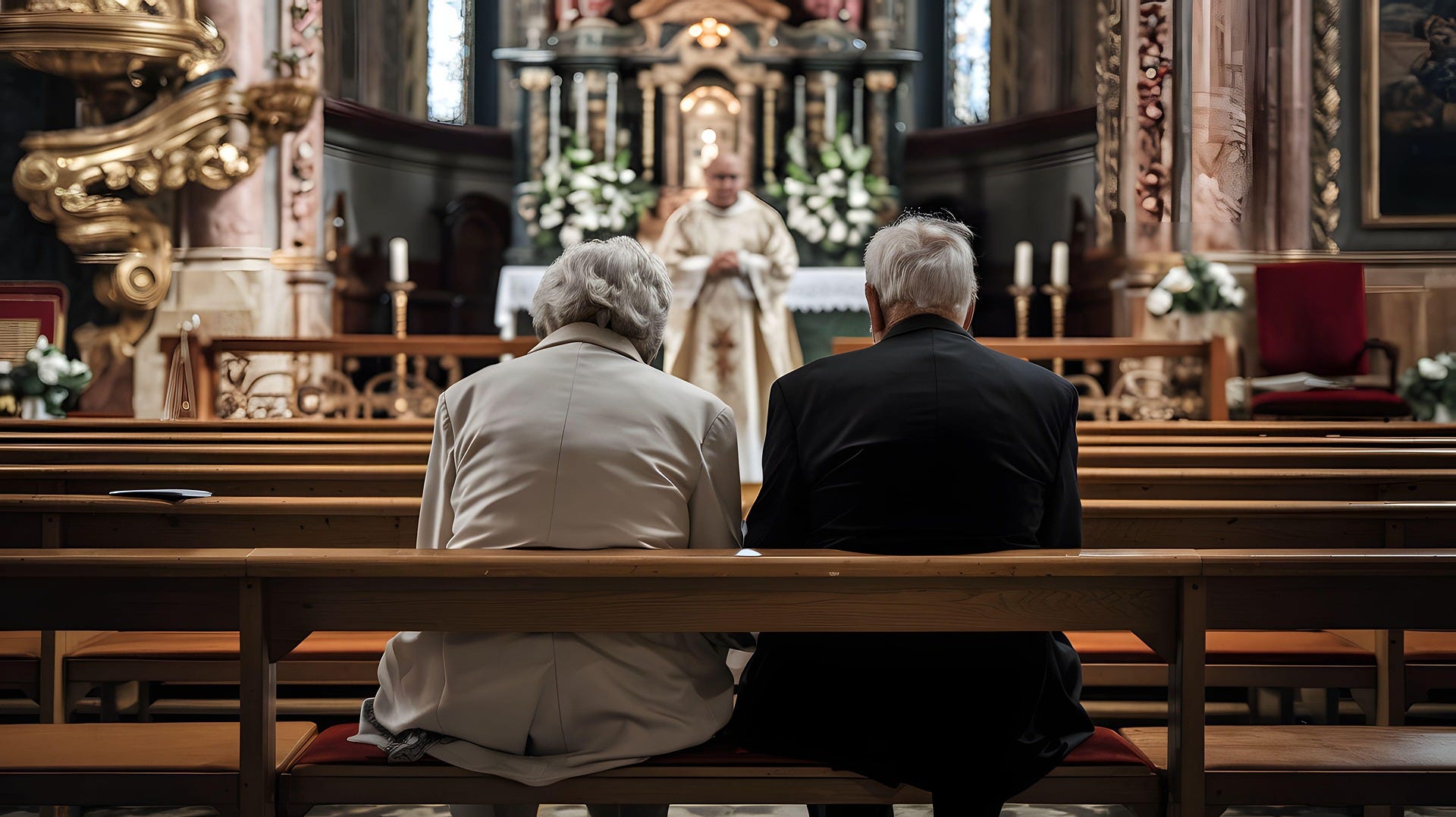
Imagine this scenario: An elderly wife has received a terminal diagnosis. She now knows how she will die. She is afraid. She does not want to suffer, nor gradually (or quickly) lose her faculties. It feels undignified. Who wants to suffer in front of their loved ones? She lives in the state of Washington, so instead, she elects to take her own life, supported by the state.
Her husband is in shock, he grieves before she is even dead. He is overwhelmed. He looks into his wife’s eyes and cannot imagine a home, or a life, without her in it. They have an adult daughter together—a human embodiment of the love that he and his wife have shared. He confides in his daughter about his grief, and further, about his fear of living alone after his wife’s passing.
In this moment of vulnerability, the daughter does not reassure him of their bond, of her companionship with him, or of their shared grief for a much beloved wife and mother. Instead, his daughter seeks a legal means by which her father can commit suicide at the same time as his wife.
This is not a novel. It is a retelling of what actually happened. The couple both committed suicide together on August 13th, 2021, her with a terminal illness and him healthy, encouraged by their daughter. The mainstream media recently lauded it as “romantic” after the daughter publicized the event.
But is it?
Or perhaps the story is the opposite of romantic, in every way. The wife chose to abandon her husband, rather than suffer alongside him and endure until God called her home. The husband, blinded by grief, could see no value in his own life as a human being, loved by God. The daughter encouraged her mother’s decision, and then went on to encourage her father’s suicide, for she would rather his death than to help him in the wake of her mother’s passing. It would seem that she would prefer to live without parents than be obliged to assist them as they once assisted her.
We have always recognized it as a grave evil to push a despairing person toward self-destruction. Our laws once treated such encouragement as a form of homicide. Michelle Carter was imprisoned for encouraging and instructing her severely depressed boyfriend to kill himself in 2014. Yet each year, so-called assisted suicide becomes legal in another state, and laws get looser on who can qualify. The father in this case was permitted into Washington’s program on the argument that since he had had mini strokes previously (from which he had recovered), he would probably have a major stroke at some point.
Dying is always going to be uncomfortable, both mentally and physically. We think of the act as undignified because we know that suffering causes us to be vulnerable, but all of these things are inherently human. It is part of the human experience to suffer, to toil, and to die. What is truly undignified is being put down like a pet, or refusing to carry the cross that is uniquely one’s own, favoring to abandon one’s family early instead. Matthew Burdette, writing for First Things, opined:
“It is a feature of human dignity to be able to face enormous suffering. The rights emerging from the sexual revolution require the non-recognition of the meaning of the human body. Likewise, the “right” to assisted suicide can only be the right not to be recognized as a human being… Assisted suicide represents a perverse inversion: a renunciation of dignity, the demand that one’s humanity go unrecognized.”
If euthanasia nixes one’s humanity, what can we say the monstrosity does to families? The family is not a mere Hobbesian contract of persons. It is an indissoluble bond, through which and because of which, civilizations may be born. To choose to be absent from it, based on (at best) a guess of one’s impending demise, is to unravel the very fabric of human continuity.
I’ve worked as a volunteer for the Crisis Text Line (previously called the Suicide Life Line) for a number of years. I have spoken with people in moments where they, too, believed that ending their life would bring relief. I learned that despair rarely needs philosophy first—it needs presence. The most effective path to help someone in that moment of despair is not existential commentary on life’s meaning, but it is in reminding a person of his inherent humanity. Thus, the most helpful response is not, “Your life has meaning and you are a creature created by a loving God” (even though that is true), but rather, “And how did you feel when you had that conversation with your dad?” Before we can move to the abstract, a person needs to feel again, and to remember that they can do so—that they have loves, interests, even annoyances. They must be reminded and connected to the uniqueness of the human experience. Even when we suffer, it helps us to understand that the type of pain we feel reflects upon our own humanity, and connects us with our fellow man.
When we societally promote suicide as a reasonable option, we reinforce that with which the depressed already struggle—the understanding of their humanity and its value. Their numbness to their own experience is echoed back at them with a societal standard that agrees with the inner monologue of despair.
It is characteristic of grief to long to be with the departed. But that very grief—that pain—is itself evidence of our humanity. It is a humanity that is being denied. To choose death is to deny God the ability to work through you on this earth and to deny family/loved ones any opportunity to be with you.
Assisted suicide encourages people who are especially vulnerable to kill themselves to avoid being burdensome. Imagine being the father who is losing his wife, and whose own daughter is encouraging his death. If you choose to live, you know that the obligation for your care might fall on someone who does not want you around. That is the effect of legal euthanasia. It forces those in difficult scenarios to feel like death is their own viable option. It reframes the darkest choice as one of compassion for those left behind.
Ultimately, these deaths are being promoted because how our non-culture sees man is fundamentally distorted. Since people are only seen in the modern era as having the value of their output, it makes sense that they would be killed when they can no longer assist the collective, and especially when they become burdensome upon it. This is why the daughter’s reasoning makes sense to a generation raised on a utilitarian ethos. If life’s worth is measured only by productivity and comfort, then death becomes an act of efficiency. We already know that the “useful part” is over, so we might as well drink the cocktail of death.
In a Christian worldview, there is value inherent in every person, and even in every moment of suffering. A baptized person is a child of God, not a disposable component of a collective machine. He’s not rusting, he’s growing, and his ability to grow spiritually is not thwarted by his suffering. Rather, in carrying our cross, we participate in the divine by sharing in Christ’s suffering. To be human is to suffer, to grieve, to hope, and to love even when those things hurt. When we sanctify the choice to die, we forfeit not only our humanity, but the chance to encounter grace in the midst of pain.
An excellent Christian synopsis of the non-Triune God culture we live in.
Thanks, Sarah, for an excellent article.